
Implications for investors of the super cycle rise in bond yields
AMP’s Chief Economist and Head of Investment Strategy, Shane Oliver said bond yields are being pushed higher due to concerns about inflation, high public debt, rising corporate borrowing, and increasing economic uncertainty.
2 minutes
AMP’s Chief Economist and Head of Investment Strategy, Shane Oliver said bond yields are being pushed higher due to concerns about inflation, high public debt, rising corporate borrowing, andincreasing economic uncertainty.
The rising trend in bond yields could dampen other asset classes as it leads to a higher yield structure in the economy. This includes residential property.
However, Oliver said it’s important to see past bond yields super cycles to understand why this is happening.
“Over the last 80 years there’s been two big secular or long term moves in bond yields – up for around 40 years and then down,” he said.
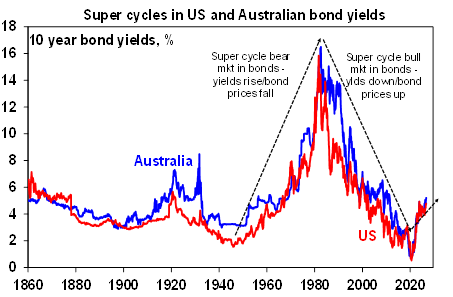
The near 40-year super cycle market that saw a rise in bond yields well into the early 1980s was driven by rising inflation off the back the Great Depression and WW2, monetary financing of the Vietnam War, rising commodity prices, protectionism and slowing productivity along with rising economic uncertainty resulting in higher real yields, and inflation expectations.
This saw 10-year bond yields in the US and Australia rise from 2-4% in the 1940s to around 16%.
Then from the early 1980s, a nearly 40-year super cycle decline in bond yields set in.
This was driven by central banks targeting inflation, supply side reforms, globalisation, lower costs and rising competition flowing from digitalisation, rising inequality decreasing spending, spare capacity and reduced worker bargaining power, just to name a few.
This saw a sharp downtrend in 10-year bond yields to around 0.5% or less in 2020.
However, starting in 2021, the long-term downtrend in bond yields started to reverse.
Several key drivers to this were:
- Higher inflation expectations
- Bigger government
- Reversal of globalisation
- Increasing defence spending
- Less workers/more consumers with aging populations making the world more inflation prone.
But what does high bond yields mean for investors today?
“The rise in bond yields has a number of implications for investors,” said Oliver.
First, higher bond yields increase borrowing costs for governments. Interest payments on public debt are now one of the fastest-growing expenditure items in the Federal Budget, accounting for around 5% of tax revenue. As bond yields rise, debt servicing costs increase, consuming a larger share of tax revenue and leaving less available for welfare payments and other public services.
Second, higher corporate borrowing costs could act as a dampener on company profit growth.
Third, banks are likely to raise their fixed mortgage rates, which will reduce the attractiveness of fixed rate mortgages as an alternative to variable rate mortgages when the RBA further increases the cash rate.
Fourth, bond returns are likely to stay mediocre. While yields are up from 2020, this will likely be partly offset by the capital loss from rising yields over time.
Fifth, higher bond yields could pose a problem for shares as they already offer a very low risk premium over bonds. A further rise in yields will reduce the relative attractiveness of shares. Right now, strong profit growth is providing an offset, but it could be an issue if profits weaken.
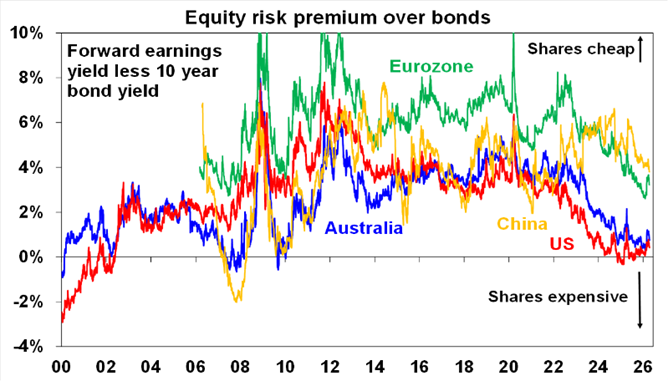
Finally, the rising trend in bond yields is reversing the tailwind of all other assets seen over the 1980s to 2020, whereby the fall in bond yields led to a “search for yield”. This led to lower yields/higher prices for most assets – shares (with higher PEs), commercial property, infrastructure and housing.
In terms of housing, it’s part of the reason why the super cycle surge in Australian home prices over the last 30 years may be over.
Important information
® North and MyNorth are trademarks registered to NMMT.
The information on this page has been provided by NMMT Limited ABN 42 058 835 573, AFSL 234653 (NMMT). It contains general advice only, does not take account of your client’s personal objectives, financial situation or needs, and a client should consider whether this information is appropriate for them before making any decisions. It’s important your client consider their circumstances and read the relevant product disclosure statement (PDS), investor directed portfolio guide (IDPS Guide) and target market determination (TMD), available from northonline.com.au or by contacting the North Service Centre on 1800 667 841, before deciding what’s right for them.
MyNorth Investment and North Investment are operated by NMMT. MyNorth Investment Guarantee is issued by National Mutual Funds Management Limited ABN 32 006 787 720, AFSL 234652 (NMFM). MyNorth Super and Pension (including MyNorth Lifetime), MyNorth Super and Pension Guarantee and North Super and Pension are issued by N.M. Superannuation Proprietary Limited (ABN 31 008 428 322, AFSL 234654 (NM Super) as trustee of the Wealth Personal Superannuation and Pension Fund (the Fund) ABN 92 381 911 598. NMMT issues the interests in and is the responsible entity for MyNorth Managed Portfolios. All managed portfolios may not be available across all products on the North platform. All of the products above are referred to collectively as MyNorth Products. The information on this page is provided only for the use of advisers, it is not intended for clients. This page provides a brief overview of some of the benefits of investing in MyNorth Products. The adviser remains responsible for any advice/services they provide to clients including making their own inquiries and ensuring that the advice/services are appropriate and in accordance with all legal requirements.
You can read the Financial Services Guide online for more information, including the fees and benefits that companies related to NMMT, N.M. Superannuation Proprietary Limited ABN 31 008 428 322, AFSL 234654 (N.M. Super) and their representatives may receive in relation to products and services provided.
North and MyNorth are trademarks registered to NMMT.
All information on this website is subject to change without notice.